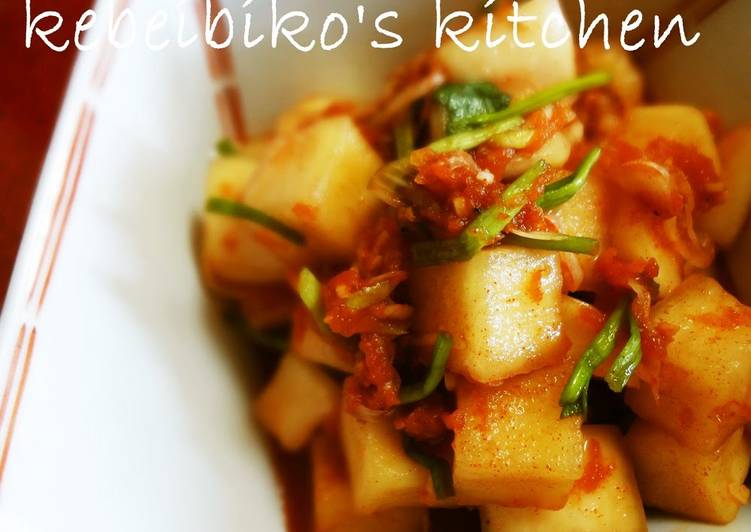
Hey everyone, it’s Brad, welcome to our recipe page. Today, I’m gonna show you how to prepare a special dish, kkakdugi (cubed radish kimchi). It is one of my favorites food recipes. This time, I will make it a bit tasty. This will be really delicious.
We Have Almost Everything on eBay. Find Your Favorite Movies & Shows On Demand. Kkakdugi (깍두기) is a kimchi made with Korean radish, mu (or moo, 무). It's an easy kimchi to make!
Kkakdugi (Cubed Radish Kimchi) is one of the most popular of current trending foods on earth. It is easy, it is fast, it tastes yummy. It is enjoyed by millions every day. They are fine and they look wonderful. Kkakdugi (Cubed Radish Kimchi) is something that I’ve loved my whole life.
To begin with this recipe, we must prepare a few ingredients. You can cook kkakdugi (cubed radish kimchi) using 12 ingredients and 13 steps. Here is how you can achieve that.
The ingredients needed to make Kkakdugi (Cubed Radish Kimchi):
- Take 1 large Daikon radish
- Prepare 2 tbsp Salt
- Get For the sauce:
- Get 1 Apple
- Prepare 2 tbsp Korean chili (finely powdered)
- Prepare 3 tbsp Fermented krill (saeujeot) (or fish sauce)
- Prepare 1 clove Finely chopped garlic
- Prepare 1 tsp Minced ginger
- Take 1 Japanese leek (white part)
- Get 2 tbsp Sugar
- Prepare 1/2 tbsp Salt
- Prepare 1/2 bunch Chinese celery (or garlic chives)
It's a very common kind of kimchi and often used in Korean everyday meals along with baechu kimchi (napa cabbage kimchi). Radish kimchi is a kimchi made out of radish and its Korean name is Kkakdugi (깍두기). The name originates from kkakduk sseolgi (깍둑설기) in Korean. It describes the motion of cutting food in cubes.
Steps to make Kkakdugi (Cubed Radish Kimchi):
- [Prep the daikon radish] Peel the daikon radish and cut into 2 cm cubes. Put in a plastic bag and mix evenly with 2 tablespoons of salt. Let sit for 1 to 2 hours. The daikon radish will release a lot of water…
- Occasionally rub the daikon from outside the bag. Thoroughly drain the daikon in a colander (let sit for about 30 minutes. In Step 4 photo, you can see that 350 ml of water drained from the daikon on the left-hand side).
- [Prepping the sauce] Grate the apple. Cut the Japanese leek in half lengthways first and slice thinly and diagonally. Cut the Chinese celery into 3 cm widths. Put all the sauce ingredients into a bowl and combine.
- After the red colour from the chill is evenly distributed, add the daikon. Stir well (if your skin is sensitive, use gloves).
- Pour the mixture into a storage container and chill in the fridge. You can eat it the following day. After 1 week to 10 days, the flavour will become well rounded. It will not be tart.
- This photo shows two day-old kkakduki.
- [Korean powdered chili] You can keep leftovers in the fridge to prevent discolouring.
- [Fermented krill] You can buy bottled ones at the supermarket and freeze leftovers.
- You can cook various dishes with it.
- "Stir-fried Potato with Fermented Krill" - - https://cookpad.com/us/recipes/145848-potato-fermented-krill-stir-fry
- "Pale Pink Edamame Bean Rice with Fermented Krill" - - https://cookpad.com/us/recipes/145337-pink-tinged-fermented-krill-edamame-rice
- "Pasta Aglio e Elio with Nanohana and Fermented Krill" - - https://cookpad.com/us/recipes/153061-spaghetti-aglio-e-olio-with-nanohana-and-fermented-krill
- "Kimchi Hot Pot Sundubu Jjigae-style"
The name originates from kkakduk sseolgi (깍둑설기) in Korean. It describes the motion of cutting food in cubes. Many Koreans say Kkakdugi made in mid to late autumn (October to December) tastes best as it is the Korean traditional radish harvest season. Kkakdugi is served as one of many banchan (side dishes) at the Korean table. Traditionally, it's eaten with long-simmered Korean bone soups — Seollangtang, Khori Gomtang, or Dak Gomtang.
So that is going to wrap this up for this special food kkakdugi (cubed radish kimchi) recipe. Thanks so much for your time. I am sure that you will make this at home. There’s gonna be more interesting food at home recipes coming up. Don’t forget to bookmark this page in your browser, and share it to your family, colleague and friends. Thank you for reading. Go on get cooking!