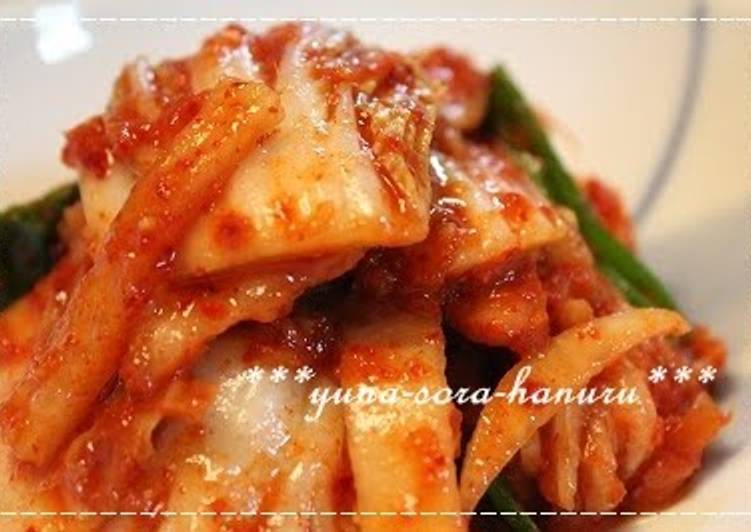
Hello everybody, it’s John, welcome to our recipe page. Today, I’m gonna show you how to make a special dish, korean kimchi from the source. One of my favorites. This time, I am going to make it a little bit tasty. This is gonna smell and look delicious.
Korean Kimchi from the Source is one of the most popular of current trending meals in the world. It’s enjoyed by millions every day. It is easy, it is fast, it tastes yummy. They are nice and they look wonderful. Korean Kimchi from the Source is something that I’ve loved my entire life.
Korean Kimchi from the Source cookpad.japan. Just when I was thinking "I want to make my own authentic kimchi!" I had a chance to learn how to do so from a Korean friend. Since then, I've been experimenting and researching the method (while receiving feedback) to come up with this recipe. The salt-preserving and draining stages for the Chinese cabbage are important!
To get started with this recipe, we must first prepare a few components. You can cook korean kimchi from the source using 15 ingredients and 16 steps. Here is how you cook it.
The ingredients needed to make Korean Kimchi from the Source:
- Make ready 1 head Chinese cabbage
- Prepare 300 grams Coarse salt (pickling salt)
- Take 100 grams Coarsely ground chili pepper for kimchi
- Take 1/2 Daikon radish
- Prepare 3 to 4 stalks Green onion
- Take 20 grams Ginger (grated)
- Make ready 30 grams Garlic (grated)
- Make ready 1/4 Onion (grated)
- Prepare 1/4 Apple (grated)
- Prepare 50 to 60 grams Salt cured ami ebi (small shrimp)
- Take 2 to 3 tablespoons Sardine extract (or fish sauce)
- Make ready 1 tsp Sugar
- Prepare 1 tsp Salt
- Make ready 60 grams Cooked rice
- Prepare 50 to 80 ml Water
When a state tabloid suggested that China had set a global standard for kimchi, social media users accused Beijing of misappropriating a Korean culinary staple. Making kimchi at a Seoul market. Rice and kimchi (also spelt gimchi) is a staple dish in the peninsula and both North and South Korea have anointed the pickled preparation as their national dish. It is no exaggeration to say that kimchi is one of the keystones of Korean identity.
Steps to make Korean Kimchi from the Source:
- Wash the Chinese cabbage, make cuts in the stem end and rip into half with your hands. Rip into half again to end up with 4 quarters.
- Make a high concentrate salt water in a large tub or bowl, and completely immerse the Chinese cabbage in it. Leave to soak so that the salt water penetrates to the core.
- When the leaves have become wilted, take the cabbage out and drain it off. Peeling back the leaves one by one, sprinkle in some salt, concentrating on the cores.
- Line the salted cabbage quarters in a pickling tub, add a weight and leave to pickle for 1/2 to 1 whole day or so. Turn it over occasionally so that it cures evenly.
- When the salt-pickled cabbage is done, rinse it well under running water. It should taste a bit salty.
- Put the cabbage on a sieve or colander and leave to drain and dry for 3 to 4 hours.
- When the salted cabbage is done, make the yangnyeom (kimchi base). Prepare each ingredient.
- Cut the daikon radish into 3 to 4 mm wide sticks. Cut the green onion into 4 cm long pieces. Grate the ginger, garlic, onion and apple.
- In Step 8, chop up the ginger and garlic and then purée it in the food processor.
- Put the rice and water in a food processor, and process until it forms a gluey paste. Adjust the amount of water depending on the consistency of the rice.
- From this point on, be sure to work with rubber gloves!! Ideally use ones that have long sleeves. Otherwise, regular rubber gloves are fine.
- Put all the ingredients in a bowl (leave out the salted cabbage out) and mix together well with your hands.
- When it looks like this it's all good (This is the yangnyeom.)
- Peel off the dried salted Chinese cabbage leaves, and spread each one with a little yangnyeom. Take special care to put plenty of yangnyeom on the cores.
- Wrap the cabbage leaves around each other with the core in the center, and it's done! Put into a sealed ziplock bag or similar, and put the bag into a sealed container and store in the refrigerator. Take out however much you'd like to enjoy each time.
- If you want to easily make a small amount, mix salted and dried Chinese cabbage that's been cut up into easy to eat pieces with yangnyeom. This is even easier.
Rice and kimchi (also spelt gimchi) is a staple dish in the peninsula and both North and South Korea have anointed the pickled preparation as their national dish. It is no exaggeration to say that kimchi is one of the keystones of Korean identity. Along with pop music and soap operas, is one of the most well-known South Korean cultural exports. Kimchi (김치) is a collective term for vegetable dishes that have been salted, seasoned, and fermented. The history of kimchi goes back to ancient times.
So that’s going to wrap this up with this special food korean kimchi from the source recipe. Thank you very much for reading. I am sure that you can make this at home. There’s gonna be interesting food at home recipes coming up. Remember to bookmark this page in your browser, and share it to your loved ones, colleague and friends. Thank you for reading. Go on get cooking!