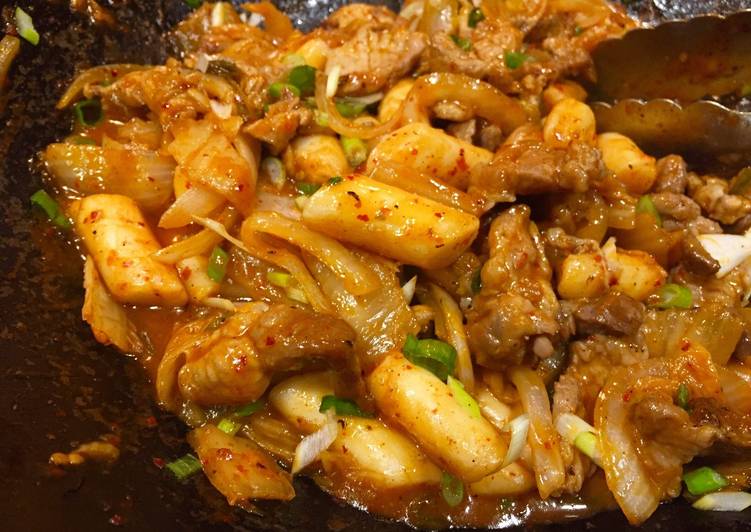
Hello everybody, I hope you’re having an incredible day today. Today, I will show you a way to make a distinctive dish, ddukbokki with pork & kimchi. One of my favorites food recipes. For mine, I’m gonna make it a bit tasty. This is gonna smell and look delicious.
Ddukbokki with Pork & Kimchi is one of the most well liked of recent trending foods in the world. It is enjoyed by millions daily. It is easy, it’s fast, it tastes yummy. They’re nice and they look wonderful. Ddukbokki with Pork & Kimchi is something which I have loved my entire life.
Brits are discovering this new way to earn more income that is Changing The UK ecomony. Add the onions and continue to saute just until onions start to turn translucent. Arrange the pork belly over the rice cakes, pouring the juices over top, then spread the kimchi over the pork belly and top with the shredded mozzarella and cheddar. Bake until cheese is melted and.
To begin with this recipe, we must prepare a few ingredients. You can have ddukbokki with pork & kimchi using 11 ingredients and 6 steps. Here is how you cook it.
The ingredients needed to make Ddukbokki with Pork & Kimchi:
- Take 1 Tablespoon oil
- Make ready 1 pound pork shoulder or belly, cut into thin slices (1/8 to 1/4 inch thick)
- Make ready 1/4 teaspoon salt
- Prepare 1/2 a small onion, cut into 1/4-inch strips vertically
- Make ready 2 cups ripe kimchi, lightly drained and cut into 1/2-inch strips (I just bunch it all together and cut)
- Take 1 Tablespoon gochujang (Korean red chili paste) to start
- Get 1 Tablespoon soy sauce to start
- Make ready 2-3 Tablespoons sugar depending on how sweet you like things
- Take 3/4-1 cup water, depending on how thick or thin you like the sauce
- Get 400 grams dduk aka Korean Rice Ovalettes that are tube shaped (not the diagonally cut flat ones)
- Take optional: chopped green onion and/or toasted sesame seeds for garnish
There are two versions of ddukbokki: a spicy version, and a sweet soy-sauce based version (good for kids since it's not spicy). This recipe highlights the spicy, more classic version. You can opt to add less red pepper paste, and even no chili powder powder at all. Kimchi Jjigae is best if it is made with pork.
Instructions to make Ddukbokki with Pork & Kimchi:
- In a wok or large frying pan, bring 1/2 Tablespoon oil up to medium high heat and then saute the pork until it's cooked through (opaque on both sides).
- Add the onions and continue to saute just until onions start to turn translucent. Add the 1/4 teaspoon salt and stir to distribute seasoning.
- Add another 1/2 Tablespoon of oil and kimchi, and continue to saute another 2 or 3 minutes.
- Add gochujang, soy sauce, sugar, and water, and stir until gochujang is mostly dissolved.
- Add dduk (rice cakes), stir to incorporate, turn the heat down to medium, and cook, covered, for 4 to 6 minutes or until rice cakes are just cooked through, stirring occasionally. (If you try to cut a piece of dduk in half with the side of a fork, the dduk should have a soft and chewy give almost completely to the bottom before you can cut through it.)
- Sprinkle with chopped green onions and/or sesame seeds if you like and enjoy! :)
You can opt to add less red pepper paste, and even no chili powder powder at all. Kimchi Jjigae is best if it is made with pork. Soon-dubu jjigae may have pork in the broth, but you wouldn't expect that to be the case. Eomuk (fish cakes), boiled eggs, and scallions are some common ingredients paired with tteokbokki in dishes. Tteokbokki (also spelled ddukbokki, ddeokbokki, dukbokki or topokki), 떡볶이, is a beloved Korean rice cake dish with many variations and a rich history.
So that’s going to wrap it up with this special food ddukbokki with pork & kimchi recipe. Thanks so much for your time. I am sure you can make this at home. There’s gonna be more interesting food at home recipes coming up. Remember to bookmark this page in your browser, and share it to your loved ones, colleague and friends. Thank you for reading. Go on get cooking!