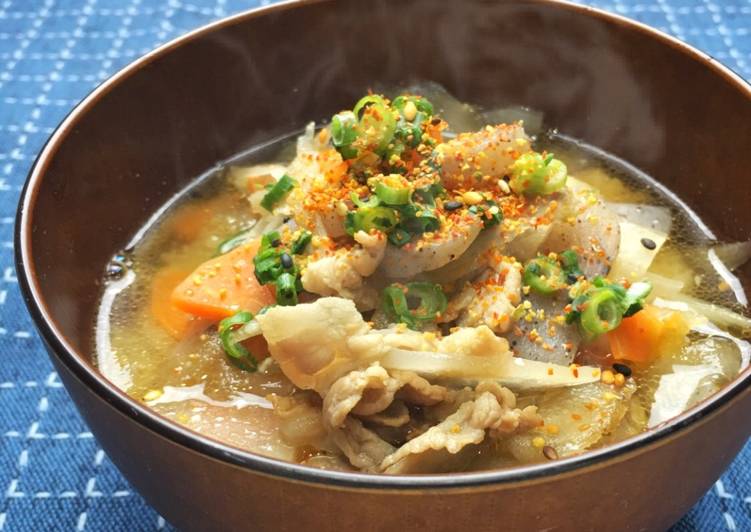
Hello everybody, I hope you are having an incredible day today. Today, we’re going to make a distinctive dish, tonjiru (pork miso soup). One of my favorites. This time, I will make it a bit tasty. This is gonna smell and look delicious.
Check Out our Selection & Order Now. Free UK Delivery on Eligible Orders! Tonjiru (豚汁) is a hearty miso soup with pork slices and vegetables. Packed with loads of vegetables and a small amount of pork, tonjiru is quite filling but you will be surprised to know the calories in tonjiru are low.
Tonjiru (Pork miso soup) is one of the most well liked of recent trending meals on earth. It’s simple, it’s fast, it tastes delicious. It is enjoyed by millions daily. Tonjiru (Pork miso soup) is something which I have loved my whole life. They’re fine and they look fantastic.
To get started with this recipe, we have to first prepare a few components. You can have tonjiru (pork miso soup) using 11 ingredients and 14 steps. Here is how you cook it.
The ingredients needed to make Tonjiru (Pork miso soup):
- Take 200 g thinly sliced pork belly
- Make ready 200 g daikon radish
- Get 100 g carrot
- Get 150 g burdock root
- Make ready 150 g konnyaku
- Make ready 1 spring onion
- Make ready 120 ml dashi stock
- Prepare 100 g miso
- Make ready 2 teaspoon soy sauce
- Take Thinly sliced green onion (garnish)
- Prepare 7 spice chili power (optional)
Tonjiru is a classic winter dish of slowly stewed slices of pork mixed with vegetables and served in a dashi and miso flavoured soup broth. A popular recipe all over Japan due to being quick, easy, versatile, and delicious, this soup is bound to become a favourite in your household as well. Even though you use the same miso paste as usual, TONJIRU will be totally different from other traditional miso soup. It is because Dashi (broth) from pork makes this miso soup great!
Steps to make Tonjiru (Pork miso soup):
- Peel the dikon radish and carrot.
- Cut the dikon radish and carrot into quarters lengthwise and then cut into thin slices.
- Wash the burdock root well, then scrape the skin with the back of a knife. Don’t peel the burdock too much as the part just under the skin contains a lot of nutrients and flavor.
- Make several long shallow cuts lengthwise all the way around the burdock root.
- Shave the burdock root into small strips over cold water and soak them for about 5 minutes to remove bitterness, then drain.
- Cut spring onion into 2 cm long pieces.
- Cut the konnyaku into thin short strips.
- Cut the pork belly into 3 cm thick slices.
- Heat the pan over medium-high heat, place vegetable oil and then add the pork and sauté well.
- Add the dikon, carrot, burdock root, spring onion and konnyaku and stir-fry.
- Once the fat from the pork is evenly coating the vegetables, add the dashi stock and simmer, skimming occasionally.
- Once the vegetables become tender, add the miso by dissolving it in a miso strainer or a ladle with some of the soup until no lumps remain.
- Add a 1 teaspoon of soy sauce.
- Serve the miso soup in a bowl, and then sprinkle thinly sliced green onion and seven spice chili powder (shichimi tougarashi) according to your preference.
Even though you use the same miso paste as usual, TONJIRU will be totally different from other traditional miso soup. It is because Dashi (broth) from pork makes this miso soup great! Using sliced pork belly is perfect, but if you can't find it, you can use the other part of pork. (Please slice it thinly.) Tonjiru or Butajiru (豚汁,とん汁,とんじる) - both literally mean pig/pork soup — is a Japanese soup made with pork and vegetables, flavoured with miso. Compared to normal miso soup, tonjiru tend to be more substantial, with a larger quantity and variety of ingredients added to the soup. Tonjiru (or Butajiru) is a kind of Miso Soup with pork and a lot of root vegetables such as Gobo (burdock root) and carrot.
So that’s going to wrap it up for this special food tonjiru (pork miso soup) recipe. Thank you very much for your time. I am sure you will make this at home. There’s gonna be more interesting food in home recipes coming up. Remember to bookmark this page in your browser, and share it to your family, colleague and friends. Thanks again for reading. Go on get cooking!